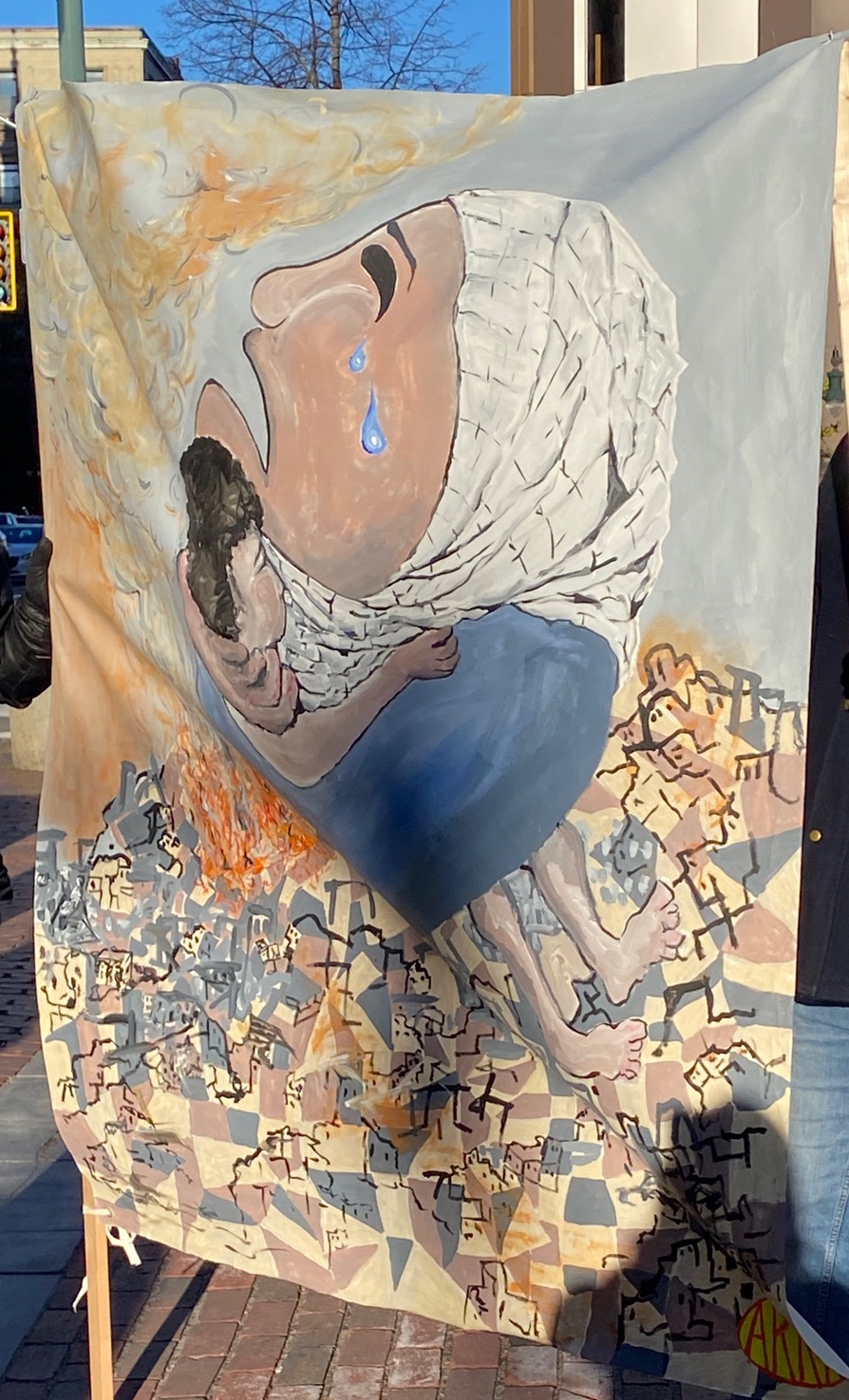
Tragedy in the Holy Land

October 7, 2023

It is heartbreaking the tragedy that is unfolding in the “Holy Land”. I fear for the safety of my dear Palestinian and Israeli friends and for all people in the region. Sadly, however, what is happening is not surprising— such are the effects of trauma heaped upon trauma. Without the deep healing necessary for a healthy psyche and for healthy relationships, the generational effects of unresolved trauma on both sides only continue to manifest in reactive, harmful, even destructive ways. This applies to individuals, families, organizations, communities, and to entire societies.

The US has been a complicit ally to Israel— we have aided Israel in its unrelenting abuse of the Palestinian people. We ignore the effects of the abuse that only someone who cannot see or someone who does not care can ignore. We haven’t stepped in to say a resounding “NO!’ to the perpetration of Israel’s treatment of Palestinians. We have not held Israel accountable. We repeatedly have turned away from the non-violent pleas from Palestinians and many Israelis for justice and recognition of full human rights for Palestinians.

Then, Hamas retaliates and now we’re paying attention— What is wrong with this picture?

Smoke and flames billow after Israeli forces struck a high-rise tower in Gaza City [Ashraf Amra/Reuters] Taken from Al-Jazeera, October 7, 2023

Thoughts before leaving for the Holy Land— 2023

On October 13th, along with 5 friends, I will return to the West Bank for a 10-day olive picking program (Keep Hope Alive) sponsored by Joint Advocacy Initiative and Alternative Tour Groups. This will be my 3rd time participating in this program and my 6th visit to the region. I will stay on for another 10 days and plan to visit several Palestinian friends; Israeli Buddhist human rights activists; a Buddhist teacher I met during an earlier visit and with whom I have corresponded; and to visit Garden of Hope, a mindfulness center being developed in the West Bank by Issa Souff, a Palestinian man who studied with Thich Nhat Hanh at Plum Village in France.

It has been 4 years since my last trip. My intention this time is to learn more so as to continue my human rights advocacy work with eyes looking through the lens of climate change: to see first-hand the effects of occupation under the current political regime and to listen to what people (Palestinians and Israelis) have to say about their day-to-day lives and their views of the future, particularly as affected climate change. I will ask questions such as the following:

FOR PALESTINIANS—

  1. Are you experiencing effects of climate change in your daily life?  If so, what changes have you noticed?
  2. Have you observed or experienced any shifts in agriculture or changes in farming practices due to changing climate conditions?  Examples?
  3. How does the Israeli occupation affect your and your community’s ability to adapt to or mitigate the effects of climate change?
  4. How do you see climate change, intersecting with the Israeli occupation, affecting the overall political and social dynamics in the region?
  5. How do Israeli policies and practices influence access to essential resources such as water, food, or shelter in your area? Have you experienced any changes in accessibility of resources as the effects of climate change become more challenging?
  6. What are your thoughts regarding how the Palestinian Authority is responding to climate change?
  7. Focusing on climate change, what are your greatest concerns regarding the future living under occupation? 
  8. What message do you want to send back to people in the US?

FOR ISRAELIS—

  1. Are you experiencing effects of climate change in your daily life?  If so, what changes have you noticed?
  2. Have you observed or experienced any shifts in agriculture or changes in farming practices due to changing climate conditions?  Examples?
  3. How are you and your community adapting to or mitigating the effects of climate change?
  4. How do you see climate change, intersecting with the Israeli occupation, affecting the overall political and social dynamics in the region?
  5. How do Israeli policies and practices influence Palestinian access to essential resources such as water, food, or shelter?  Are you aware of any changes in policies and practices related to provision of resources as the effects of climate change become more challenging?
  6. Focusing on climate change, what are your greatest concerns regarding the future?  For the Palestinians living under occupation? 
  7. What message do you want to send back to people in the US? 

Cultivating Compassion In the Midst of a Broken Society — Thanissara

This week marks the 50th anniversary of the Six-Day War where Israel fought for its ability and right to exist as a nation. On the other side from al-Nakba, (the Day of Catastrophe marking the Palestinian experience of a devastating loss of their homelands in 1948), leading onto the occupation (of the West Bank and […]

via Cultivating Compassion In the Midst of a Broken Society — Thanissara

SILENCE IS NOT AN OPTION—A September 2014 blog post I did not publish

Written 9 years ago. Not only is it still relevant, but the situation in Gaza is catastrophically worse.

Since my last post I have been struggling with feelings of despair– “Operation Protective Edge” was for all intents and purposes a war on civilians living in Gaza– a vast number of whom were children under the age of 18.  During the assault (which, thankfully, has ended) I was glued to my FaceBook looking for messages from my friends living in Gaza and the West Bank.  I longed for their safety and for the safety of Palestinians I’d never met.  My sleep was irregular, interrupted by images I’d seen earlier each respective day of mutilated bodies, many being children; anguished and tired faces of Gazans; destroyed buildings–white dust, dirt, rubble, fragments of what once were homes and work-places; and the color red.  I can only imagine that the pain I felt in my heart-mind was like a drop of water in an ocean compared to the pain the people there were experiencing.  I didn’t sleep well, my heart and mind screamed in agony over the lost lives and the senselessness of it all.  As said by someone, I can’t remember who, I thought–“Silence is not an option.”

I needed to DO something, so in addition to my continued repostings of articles, essays, reflections and photos coming out of Gaza and the West Bank and from reporting organizations I trust and respect and participating in local Portland, Maine rallies, I began drafting a petition for Buddhists to join me in supporting an arms embargo on Israel.  I consulted with Stephen Fulder, leader of the Insight Meditation community in Israel; I consulted with Thanissara, a dear and deeply compassionate Buddhist teacher-in-the-world I have learned from over these past few years.  They wrote back to me, guided me, supported me as I thought through and wrote the petition.  Thank you, dear Stephen and Thanissara–

Even so, Buddhists tend to be very quiet on this issue.  Views are influenced by the lens through which we look. And we all benefit when we look deeply into the conditioning factors that shape our views. What is wise, skillful speech and action arising from right understanding; what are the manifestations of our ignorance (i.e. avoidance)–and how do we know the difference?

In the meantime, the world doesn’t wait for our understanding.

#7 Reflection: A Sad Interlude—July 24: 18 days now

If you are neutral in situations of injustice, you have chosen the side of the oppressor.  
Desmond Tutu
1__#$!@%!#__unknown
(and, then there is ignorance…)

I sit here on the back deck of my home listening to bird sounds, the rustling of leaves from a slow-moving breeze and the distant movement of traffic.  I see moving light on the pond at the bottom of the field below.  I look out onto gardens filled with varying shades of yellow, white, green, and my eyes rest on the peaceful face of the Buddha statue under the apple tree.  What teaching do you have for me this day, dear Siddhartha Gotama, while bombs are falling in Gaza and the people who live there are dying, injured, displaced from their homes?  While, too, my friends in Israel suffer from fear and despair wanting to do something, but feeling ineffectual?

I wake up at night and immediately my head is filled with worry and concern about the people of Gaza.  I check my Facebook to see what news has been posted (I have learned not to rely on the mainstream media for accurate reporting), to see if Khitam has written anything—to know she is alive, uninjured; to let her know I am listening and speaking up.   I look for messages from Rose, my friend from Ramallah; Hamde, from B’ilin.  I follow other friends in human rights organizations I trust and respect:  Jewish Voice for Peace, US Campaign to End the Occupation, Interfaith Peace-Builders, B’Tselem, If Americans Knew, Breaking the Silence and others.  And “share” what I learn (some would say too much).  I read articles and essays and look at photographs that I don’t want to look at.  The most painful ones for me are pictures of mutilated bodies of babies and little children and the anguished faces of their tormented parents.

A couple of days ago, Bob received a call from our friend, Yasser, telling us that two 14 year-old boys from his town, Al-Ram, had just been shot dead by Israeli soldiers (we still haven’t heard about this in the news).  Bob could hear gunfire in the background along with the sound of fear and despair in Yasser’s voice.  Yesterday, we received an email from our Israeli Jewish friend, Iris, who lives just outside Tel Aviv.  She, too, is despairing and deeply frightened.  She and many of her Israeli friends are frantically meeting, planning and organizing protests rallies and events. (We don’t hear about these actions here in our media either.) Her son has refused to sign up with the Israeli Defense Force (IDF).  He won’t have blood on his hands, be part of actions he believes are morally wrong.   He is one of many Israelis doing what he can to end the horror that can have no end from continued acts of horror.  And, as an Israeli citizen obliged to serve his country, there will be consequences.

As I sit in the quiet and safety of my home, I feel tired, deeply sad; and I feel the desire to turn my head away from it all.  (Quickly the thought arises—with judgment and scorn— “YOU are tired!?”)  I do know I need to rest and spend even a few minutes by the pond at the bottom of the field behind my house—to rest in “The Peace of Wild Things”.*  And, then feelings and thoughts of shame arise: this country to which I pay taxes uses over 3 billion of those tax dollars each year to fund the government and military that is massacring the people of Gaza, taking without permission or compensation land that is not theirs, intimidating, restricting, constricting the lives of an entire group of people, letting them know through speech and actions—“you do not belong here.”   My heart screams in agony for the people of Gaza, for the people of Palestine—for the ignorance that perpetuates the violence and occupation of the Palestinian people…that affects the people of Israel and the sustainability of the state of Israel…that affects us all.

It’s all there in what is unfolding, isn’t it?  The truths of kamma (cause and effect), anatta (not-self and the illusion of a sense of identity and separateness), annica (impermanence), dukkha (unsatisfactoriness and suffering).  And, ignorance, like the trump card, is the most powerful part of it all.

I keep hearing in my head the words of Jesus as he was dying on the cross:  “Forgive them Father for they know not what they do.”

*title of a poem by Wendell Berry

#6 Reflection: The roads, the car, the driver & the passenger

 Image

Yasser’s car


“My students want to learn about Buddhism. Will you come and talk to them?” The invitation Yasser’s invitation to speak to a classroom of young Palestinian women about Buddhism delights me. So, on Saturday morning (not considered the weekend here) I have my simple breakfast of coffee, toast and banana; get dressed for the day in light-colored linens—loose fitting pants and a long-sleeved blouse—appropriate for and respectful of the more conservative aspects of the culture; gather together what I will take with me; and wait with Bob outside the apartment building for Yasser to pick us up. (We pack carefully since neither of us is eager to climb twelve flights of stairs to retrieve what might have been forgotten.) As we wait alongside the dusty, dirt road near the apartment building, we watch children of all ages, boys and girls, neatly dressed in their school uniforms and carrying backpacks walk towards school. Some are in cars driven by a parent. This is final exam time, and a few of the children carry an open book and appear to be doing some last-minute review of whatever subject they will be tested on today. We are greeted with smiles from most who pass us, and, with glances back over the shoulder, several of the children get another look at these foreigners standing on their street. I wonder what they see through their eyes as they look at us.

We see Yasser’s dark maroon Opel coming up the hill, a cloud of dust billowing behind it. Yasser loves this car—he says it is like a good friend: familiar and reliable. While it is well-worn (windows that won’t close completely, a back door that when closed has a space around the edges allowing air to blow inside, dents in various places on the body of the car, the absence of hubcaps), it is well cared for, too. Yasser keeps it very clean and maintains it properly with regular check-ups and servicing.

We climb into the car, Bob in the front seat and I in the back—definitely my preference since Yasser drives fast and hard and the roads are rough. And, there are no clear rules about driving here, so at times the movement of traffic seems chaotic and scary (to me). He is a competent driver, however, and his demeanor is calm and steady (betrayed only by his regular little toots of the horn as he maneuvers in and around and through the driving terrain). I refrain from back-seat driving tendencies—although it is hard for me—and breathe through anxiety that arises. While I am not in control of the driving, I can influence how I respond to it. I am aware that this is a very good “letting-go” practice, and I feel moments of calmness and an easing of tension in my body.

As I sit in the back seat mindful of my breathing and the tightening and relaxing of my body, I look out the rattling (but clean) window and begin to think of the condition of cars and roads and how they tell a story of life here in Palestine. People here do the best they can with what they have. On a daily basis, they negotiate rough, unpaved roads; respond to omnipresent potholes; wait for long periods of time at check points while breathing in dust and exhaust fumes, all the while uncertain about how the 19-year-old Israeli soldier will respond to them when they are (and sometimes are not) allowed through. And, a 5-minute drive takes up to an hour or more. With few exceptions, their cars are old, battered and worn.

This is the way it is: at least how it has been for many years and how it will be for who knows how much longer. The Palestinian people have learned to practice restraint and samoud, steadfastness, as they live with knowing they have little power in this Holy Land that has been their home for hundreds of years. Like us all, they are not in control of the unfolding of their lives; and, like us all, they can influence the ways in which they respond to their lives. But, while it is true that we all experience the gritty and unsatisfactory inevitabilities of life—loss, sickness, aging, death—it is also true that we are not all living by the same set of rules.

Palestinians living in Israel, the West Bank and Gaza are denied many of the human rights I have taken for granted in my life. Living in a Palestinian community, I am seeing this more than ever before—and there are times in the seeing when I feel deep shame. I am learning from the Palestinian people in ways I hadn’t expected. While the practice of and experience of restraint and patience in the mind-body-heart may be similarly felt, the “normal” circumstances for practice in many ways are vastly different. I have a day-to-day ease in living circumstances they do not have. I live with the fundamental privilege of knowing that—while exceptions are always possible—for all intents and purposes, my human rights are protected. Such is not the case for the Palestinian people.  And, knowing this I wonder—what would it feel like and how would I do with these added layers of loss in the inevitability of life experience?

Rights denied to Palestinians:

  • The right to marry and live with the person they choose, regardless of where that person might presently live, and to bring their family together in the home of their choice;
  • The right to live without fear of their homes being arbitrarily demolished by bulldozers;
  • The right to dig wells on their own land or otherwise gain access to adequate clean water;
  • The right to protection against unreasonable intrusions and searches, and against arrest and imprisonment without due process of law;
  • The right to own property that cannot be seized and given to others on the basis of religion or ethnicity;
  • The right to their children’s protection from unwarranted arrest, abuse and imprisonment;
  • The right to freedom of movement throughout the Palestinian territories;
  • The right to non-discriminatory planning, zoning, construction, development, provision of public services, and use of scarce area resources;
  • The right to protection & redress against discriminatory racism, including denial of educational opportunities as well as abusive and violent actions by military, police, and hostile settlers;
  • The right to nonviolent protest against unfair laws and policies without state harassment, arrest, & imprisonment;
  • The right, internationally guaranteed by UN Resolution 194, “to return to their homes [from which they have been expelled from 1947 to the present] and live in peace with their neighbors”. (Resolution 194 has been affirmed over 110 times since it was approved in 1948.);
  • The right to national self-determination within their own land.

How would I do with these added layers of loss in the inevitability of life experience?

May my heart know your heart…May we be free from the delusion of separateness.


#5 Reflection: The Three Jewels– Teachers, Teachings, Community

A high school graduation in Palestine: it never entered my mind to seek out such an opportunity, but here we are with our friend, Yasser, one of the teachers at the Rosary Sisters’ High School, a private Catholic girls’ school in Beit Hanina. It is near 5:00 PM on a Thursday evening—we’re not late, but we arrive later than scores of students and their families, so parking is a problem. Cars are tightly parked in every available space and are angled this way and that. Yasser is unable to park in the faculty lot because it is already filled…so he drops us off and goes searching for a space. When we enter the auditorium, it is already filled with people holding balloons and flowers and cameras. All ages of people are dressed up for this celebratory occasion—suits and ties, colorful dresses and hijabs.*

We are seated in the front of the room, just behind Yasser, in a place reserved for “special guests.” I am the only blond-haired person in the room—casually dressed, too (we thought we were going to a party—a problem in translation), so I feel a bit obvious. We are in an auditorium with a balcony at the back of the room and a stage in the front of the room. The school’s logo is projected onto a screen, high up on a curtain at the back of the stage, in a “now-you-see-it, now-you-don’t” kind of rotation. A set of bleachers frames each side of the stage at 45-degree angles. There is laughter and excited chatter of voices speaking a language I can’t understand, so I experience the voices as percolating sounds bubbling around me. It is interesting to be immersed in a room filled with voices and not understand what is being said—to just listen without word-meaning distraction.

As the young women enter the room in a procession with their teachers, there is excitement and joy: clapping, cheers, smiles and the flashing of cameras. The young women are dressed in their school uniform—a red and blue plaid jumper with a long-sleeved cotton white blouse—and, with the exception of two (one with dark blond hair, the other with red hair), they have long, dark and carefully styled hair. Ninety-four young women file onto the bleachers, and their faces are beaming.

During the next two hours, we hear selected students presenting their parting thoughts in three languages: English, French and Arabic. We observe underclasswomen dancing—their bodies held straight and strong: classical ballet, contemporary modern, and the dubka, a traditional Arab folk dance. We hear singing of the national anthem of Palestine and see pride in the countenance of these young women.  And, finally, we watch each student being acknowledged as she receives her diploma from the principal of the school, Sister_____.

The room is significantly warmer than it was earlier and on the stage where the young women who have received their diplomas are standing, even warmer. About mid-way through the awarding of diplomas there is the sound of something dropping on the stage, followed by alarmed voices, a break in the composure of students standing there, and a rush of movement towards the back of the stage. A student has dropped to the floor. Then, from another section of the stage, another student drops to the floor. A doctor in the audience rushes to the students, as do several parents concerned for their daughters. After he checks them out and they are helped off the stage, we learn that they have fainted–probably an effect of the heat and insufficient intake of water–and are otherwise OK.  As the room’s anxious energy calms, the ceremony continues.

Later that evening, as we return home to our apartment, Yasser tells us that before the graduation ceremony there had been a protest outside the school. This year, like the many years before, the principal has not allowed Muslim girls who wear the hajib to do so at graduation. They either comply with this restriction or not participate in the ceremony. So, sixteen girls this year did not participate. (The nuns, including the principal, however, have always worn their head coverings, as they did this evening. I find this curious.)

Teachers, teachings and a supportive community—The Buddha understood the importance of these three elements (referred to as the “Three Jewels”) in following a spiritual path. Aren’t these elements, too, important on the entirety of the journey that is our life? Couldn’t living life be described as a spiritual journey—a seeking of meaning and purpose and happiness?   All are present here this evening.

These young women manifest the fruits of the teachings provided by their teachers and the love and support they have received from their community. Seeds not yet sprouted have been planted, too. Just as soil is prepared to nourish and sustain the growth of flowers and plants and trees, so the minds and hearts of these young women have been prepared to grow in wisdom, strength and compassion.   Life’s roughness and richness and sorrows and joys will be the nutrients; and the “three jewels,” the soil and the seeds.

In occupied Palestine, the roots of life and connection to the land are strong.  With continued nourishment and proper conditions, these young women will grow and flourish— May their lives be of benefit to the people of Palestine and to all beings near and far.


*Headscarves covering the hair of Muslim woman. (Contrary to what many people believe, not all Palestinians are Muslim and not all Muslim women choose to wear the hijab. Also, the hijab is not the same as a burka, which is a full face and body covering.)

#4 Reflection: Palestine through the sense doors—feeling and thinking

In Bitiir, a Palestinian village near Bethlehem, I learn from Hassan, our guide and the director of Batiir Landscape and Ecomuseum, that on June 15th UNESCO will be voting on a proposal submitted by the town to designate the village a World Heritage site. If this designation is not given, Israel will build a separation wall through the terraced farmland and its irrigation system destroying not only an ancient technology, but also an ancient culture and way of life.   He walks with us through the village showing us the irrigation system developed by the Romans over 2000 years ago: a natural spring supplies the water that flows through a simple but sophisticated network of narrow channels that meander through the terraced gardens below. For many generations, eight extended Palestinian families have farmed the land here sharing equally the daily supply of spring water gathered for irrigation in a pool at the top of the hill. It is a system that requires cooperation between the families—each family is allowed a measure of the water available for the day. When the designated amount has been used in one family’s section, the water is diverted to the next family’s section by closing off the flow in one section of the channel and opening it up into the next leg of the channel. And on and on it goes—every day of the growing season, every year without disruption.  I asked Idadl (a town council member) if conflict ever arose around the sharing of the water.  She replied “I have lived here all of my life, and I’ve never known or heard of any problem. We work together—if we didn’t all of our gardens would suffer. And, if our gardens suffered, so would we.”

Such it is in this land (as it is everywhere)—to do harm to others is to do harm to oneself. Sadly, the wisdom that is part of religions and spiritual practices throughout the world is not evident in the actions of the Israeli occupation of the Palestinian territory. Everywhere are signs of the Occupation: barbed-wire fences, forty-foot concrete walls and watchtowers, Israeli-only highways, electrical grids and wires connecting the daily expanding settlements and “out-posts” (rudimentary housing structures that precede the building of a new Settlement) that cut up and eat into what remains of Palestinian land.  And now, here in Bitiir—this ancient and beautiful village is at risk for being gobbled up to satisfy Israel’s insatiable desire for more land.

As I walk through the village, my heart is heavy and feelings of anger, fear and sadness arise. Through this vessel experienced as me, I watch the mind and body respond to what walks through the sense doors: the sound of a panicked scream arises in the mind—“No…Stop…Enough, already!” I feel the heart tighten and close, then open, then tighten again…the sensation of tears comes. I practice relating to thoughts and feelings arising with compassion and understanding. I practice noticing and opening into life here as it is—seeing suffering in and around it all, not just the suffering of the Palestinian people, but of the Israeli people, too.

And, I remember the Buddha’s teachings on anattā (not-self) and the unfolding, impersonal and conditional nature of life; that what is happening now is the result of innumerable and dynamically interacting conditions over time. And, because conditions and the effects of dynamically interacting conditions do continually change, and when the trajectory of change is increasingly influenced by actions rooted in doing no harm and in wisdom and compassion (there is good evidence suggesting that this is the case), the unfolding results will be towards the common good. While I have faith in this, I struggle with patience, and sometimes, feelings of despair—how much more destruction and violence will happen before reaching the tipping point?

In this moment and many others, I find comfort and inspiration in the calm, steadfastness (samoud) of the Palestinian people with whom I travel. Remembering the words of poet William Stafford: “justice will take us millions of intricate moves” (from the poem, Thinking for Berky), I breathe in deeply and let go.

#3 Reflection: Palestine through the sense doors—smelling and tasting

One:
Standing on the terrace of Yasser’s apartment I smell the aroma of food being prepared below—the spices and meats of traditional Palestinian cooking. Depending on the direction of the wind, the smells are more or less intense, and they become mixed with the smell of burning trash nearby.

Two:
Lama, Yasser’s niece, invites us to dinner—her four children greet us, at first with a reserved curiosity, but after we learn their names (and clumsily attempt to pronounce their Arabic names correctly: Dania, Carmel, Alama, Ahmad, Kenda) and ask them questions about school—their favorite subjects and activities—they relax and smile and talk with us in English far better spoken than we will likely ever be able to speak in Arabic. The table is set and a feast is served of chicken and potatoes roasted with olive oil and sumac and other spices; a chicken in a creamy sauce, and meatballs prepared with a mixture of spices traditionally used in Palestinian cooking; green salad; and rice with roasted almonds and vegetables. My taste buds receive the stimulation and my mind responds in the affirmative: “Yes—I like the taste of all of this! More, please!” The tastes experienced continue to please even while the body’s message—“Stop…enough already!” — is felt more and more. Arabic coffee, dark roasted and spiced with cardamom, is served along with a chocolate covered, chocolate mousse filled cake. While my body is full from an excess of food (and I’m not feeling so well), my heart is full in a different way– Lama’s love and her generosity are conditions that contribute to the arising of joy I am feeling in my mind, body, heart.

Three:
It’s early morning and I wait for Yasser to pick me up and take me to the bus station in West Jerusalem that will take me to Tel Aviv for a meeting with Buddhists in Israel (more about this later.) The sky is clear and the breeze is steady and cool—a pleasant sensation on my skin. I watch children walking, on their way to school, and many cars pass by with families and individuals heading somewhere. Dust clouds form and move into the air as tires make traction on the unpaved street. The trash pile (plastic bags, cardboard boxes, food waste, broken glass, aluminum cans) has become larger since we arrived in the neighborhood, and it has become more unpleasant—the sour smell of spoiled meat, feral cats eating from the trash, wind blowing the lighter trash around in the empty lot. Yasser said the town would be coming to take it away—but they haven’t arrived yet. Such a contrast to the neatness and cleanliness inside the apartments I’ve visited in this same area.

I see a well-dressed man leave his apartment across the street from where I am standing—he opens, then enters his garage, on the ground level of the apartment building, and when he backs his car out he is in a dusty, but otherwise very nice BMW. So close to the trash that all I need to do is turn my head slightly to see it. And, the continuing wafting of sour, spoiled meat. There is not adequate money available to the municipality here (and throughout Palestine) for necessary equipment or a proper facility for waste disposal and management. Sadly, this is another consequence of occupation and the restrictions Israel imposes on the people of Palestine.

As the week unfolds, I will experience pleasant and unpleasant sensations and joy alongside of deep sorrow as our journey takes us deeper into Palestine and the lives of the Palestinian people.

#2 Reflection: Palestine through the sense doors—hearing and seeing (part one)

We are living in the top floor (6th) apartment belonging to our friend, Yasser, in a section of East Jerusalem known as Aram, a suburb of Beit Hanina. The apartment is situated on the highest point in the area, so the view is unobstructed—Jerusalem to the left, Ramallah slightly to the right. From the airport in Tel Aviv it is about a 45 minute drive. Bleached blue sky; bright white buildings; dusty dark green of trees, shrubs and the sparse smattering of grasses; and the light tan to white of sand, rocks, concrete and dried out branches of palm trees and grass.  Here and there are flowers—what look like yellow mustard and Queen Anne’s lace growing wild, and the various shades of pinks and reds of cultivated flowering bushes and flowers I don’t know the names of. Neat, trimmed, well organized, lovely to my eyes.

It is very clear where the boundaries are between Israel and Palestine, whether official and legally defined or illegal (settlements and outposts). Israel has the privilege of watered landscapes and well-financed infrastructure and public services, while Palestine does not. So, in East Jerusalem and the West Bank, it is drier, dustier, trash-cluttered; many of the streets and roads are dirt, stones and rubble, narrow with potholes. Trash is burned in large rusty metal containers (dumpsters or barrels) placed along streets of neighborhoods–black smoke indicating the locations.

I stand on the terrace outside Yasser’s apartment and look over the neighborhood all the way to Jerusalem and Ramallah. Children are playing below—kicking a ball, chasing after one another, boys throwing rocks at a target they’ve constructed with rusted barrels and plastic bottles. I hear their voices, familiar child voices—yelling, laughing, high child voices, excited and playful. I also hear birds chirping, the distant sounds of cars nearby, and the wind. The Islāmic “call to prayer” –the voices of men (imams—Islamic worship leaders), song-like, reciting sections of the Koran– can be heard from minarets in various places around the area. There is a kind of sound-around effect—sometimes nearly synchronized, sometimes like a call and response—exotic to my ears that are unfamiliar with the Arabic language.   In the distance, I hear the sound of a siren.