
From an anonymously written poem, these words resonate for me like no other expression of grief I’ve come upon. “Sadness set on fire” is for me what is deep in my body, a swirling mess of sadness mixed with anger—a deep, pervasive, pressurized anguish. Except that during this year of genocide in plain sight, my body has done what the body tends to do— it has shut down, become desensitized to the sounds and images of horror. Tears won’t come, they just won’t. My eyes still see, my ears still hear, my mind still thinks, but then there is a block, a separation, a kind of door that keeps out or keeps in (depending on perspective) emotions felt as sensations in my body.
It is for protection, I have no doubt. Not unique to me. A way the (my) human body has adapted to mental and physical pain when the pain is experienced as too much to bear. Blocked, buried, suppressed until something, some unforeseen condition (a word, a smell, a picture…) unlocks the door, cracks it open, and the built up anguish pours out. Like in flash flooding, emotions when built up and then released have a way of being a muddy mess and a potential danger to what is downstream. A deluge of tears, screams of heartbreak, a pressure-cooked body all mushed together with unresolved traumas from long ago. There’s nothing clean about it.
This is trauma, a natural history of trauma. But what I experience is trauma from being witness to, not being in the direct path of, forces intent on destroying.
Now imagine this trauma:
Imagine tens of thousands of people corralled without exit, never knowing if you will be the target of a sniper, a drone programmed to execute, a bomb of shrapnel. Or knowing without doubt that food is being withheld from you, your children, your elderly mother. That you may starve or die from illnesses run rampant from garbage and sewage and buried corpses of dear friends and little children rotting into the ground. That winter is coming with its cold rain and harsh winds— that your tent may not be strong enough for the storms, that there are few blankets and even fewer layers of clothing warm enough to protect your already cold body. Imagine.
Imagine the faces—gray, stress-lined, old, skeletal. Eyes blank and staring, some encrusted with dirt mixed with dried tears or the pus of infection. Or young mothers with gnawing bellies, wasting bodies, and empty breasts, unable to feed their babies, and wracked with terrible guilt when their infant cannot survive. A vehicle for life, a vehicle for death.
My dear young friend, Dr Jehad Hasanain, is in the midst of all this human-caused suffering. He’s a survivor. He wonders for how long, though. How long can a human spirit survive even if a body does?
He recently wrote words that cracked open the door of my emotions. I read them out loud and I heard his voice through my own and I sobbed.
[From Dr Jehad— Sunday, November 17, 2024]
“I don’t really know what this world wants from us. We are a people whose rights have been taken away for decades. We are trying in every way to live in peace. But this world refuses to listen to our voices, trying to crush us as if we are not human beings. We feel, we dream, we hope. We are not heroes and we are not criminals. We are just human beings!
My God, what have we come to?
Do you know that people go to bed hungry? It used to be the poor who complained of hunger. Now most of the people are poor and most of the people go to bed hungry. No flour! No bread, no vegetables, no tinned food, no fruit. There are some very simple items available here and there, but at astronomical prices that no one can afford.
The fatal thing is that there is no horizon!
There are no landmarks for the future. Everyone wants to open the crossings to escape the hell of Gaza. That’s what we’ve come to. Our day in Gaza is full of shelling, bullets, tanks, planes, soldiers, searches, killing, blood, screams, pain, sadness, hunger, poverty and humiliation.
I don’t know what to say except that I’m tired. I’m tired of everything. I feel like many parts of me have died. And I feel that my memory has been eaten by the war. I find it difficult to remember my former beautiful days.”

CROWDS OF PEOPLE TRYING TO GET BREAD


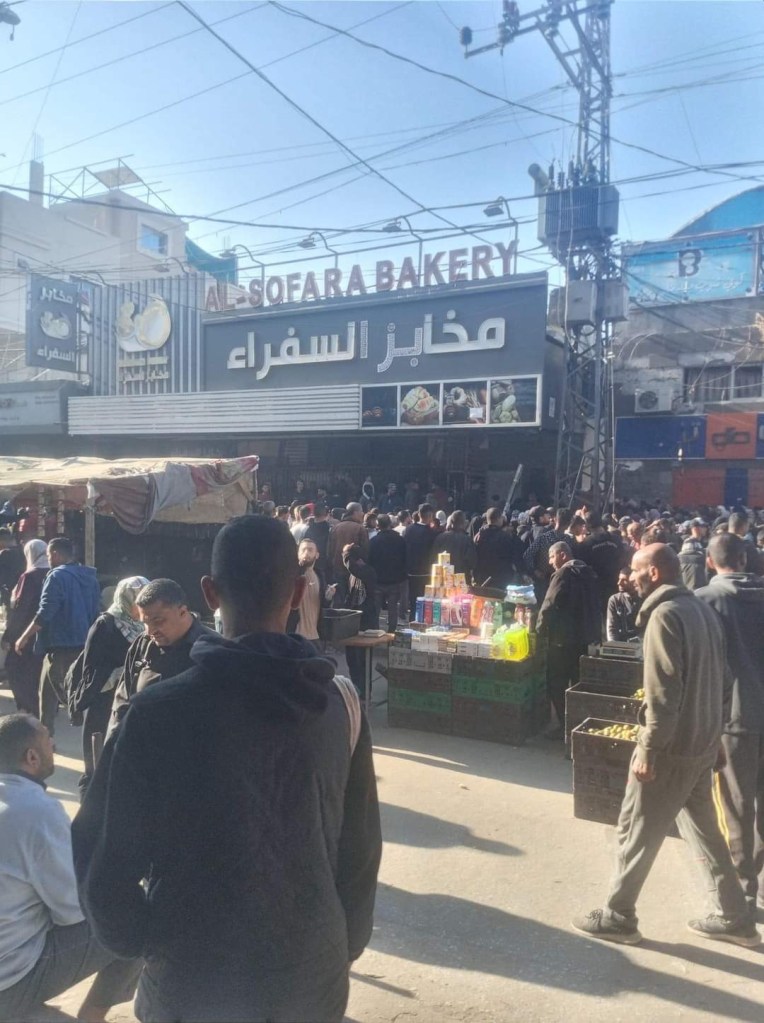

(Photos sent from Dr Jehad Hasanain)
 Buddhist Travels in the Holy Land
how can one not despair? Humanity is broken. 😞 my political actions feel so feeble.
powerfully written, Sally, thanks. How will they survive?💔
I want to find the words but I don’t possess them. The horror they live through is unimaginable. I appreciate the compassionate way that you have to share their situation