Featured

“Sadness Set On Fire”

From an anonymously written poem, these words resonate for me like no other expression of grief I’ve come upon. “Sadness set on fire” is for me what is deep in my body, a swirling mess of sadness mixed with anger—a deep, pervasive, pressurized anguish. Except that during this year of genocide in plain sight, my body has done what the body tends to do— it has shut down, become desensitized to the sounds and images of horror. Tears won’t come, they just won’t. My eyes still see, my ears still hear, my mind still thinks, but then there is a block, a separation, a kind of door that keeps out or keeps in (depending on perspective) emotions felt as sensations in my body.

It is for protection, I have no doubt. Not unique to me. A way the (my) human body has adapted to mental and physical pain when the pain is experienced as too much to bear. Blocked, buried, suppressed until something, some unforeseen condition (a word, a smell, a picture…) unlocks the door, cracks it open, and the built up anguish pours out. Like in flash flooding, emotions when built up and then released have a way of being a muddy mess and a potential danger to what is downstream. A deluge of tears, screams of heartbreak, a pressure-cooked body all mushed together with unresolved traumas from long ago. There’s nothing clean about it.

This is trauma, a natural history of trauma. But what I experience is trauma from being witness to, not being in the direct path of, forces intent on destroying.

Now imagine this trauma:

Imagine tens of thousands of people corralled without exit, never knowing if you will be the target of a sniper, a drone programmed to execute, a bomb of shrapnel. Or knowing without doubt that food is being withheld from you, your children, your elderly mother. That you may starve or die from illnesses run rampant from garbage and sewage and buried corpses of dear friends and little children rotting into the ground. That winter is coming with its cold rain and harsh winds— that your tent may not be strong enough for the storms, that there are few blankets and even fewer layers of clothing warm enough to protect your already cold body. Imagine.

Imagine the faces—gray, stress-lined, old, skeletal. Eyes blank and staring, some encrusted with dirt mixed with dried tears or the pus of infection. Or young mothers with gnawing bellies, wasting bodies, and empty breasts, unable to feed their babies, and wracked with terrible guilt when their infant cannot survive. A vehicle for life, a vehicle for death.

My dear young friend, Dr Jehad Hasanain, is in the midst of all this human-caused suffering. He’s a survivor. He wonders for how long, though. How long can a human spirit survive even if a body does?

He recently wrote words that cracked open the door of my emotions. I read them out loud and I heard his voice through my own and I sobbed.

[From Dr Jehad— Sunday, November 17, 2024]

I don’t really know what this world wants from us. We are a people whose rights have been taken away for decades. We are trying in every way to live in peace. But this world refuses to listen to our voices, trying to crush us as if we are not human beings.  We feel, we dream, we hope.  We are not heroes and we are not criminals. We are just human beings!

My God, what have we come to? 

Do you know that people go to bed hungry?  It used to be the poor who complained of hunger. Now most of the people are poor and most of the people go to bed hungry. No flour! No bread, no vegetables, no tinned food, no fruit.  There are some very simple items available here and there, but at astronomical prices that no one can afford. 

The fatal thing is that there is no horizon!

There are no landmarks for the future. Everyone wants to open the crossings to escape the hell of Gaza.  That’s what we’ve come to. Our day in Gaza is full of shelling, bullets, tanks, planes, soldiers, searches, killing, blood, screams, pain, sadness, hunger, poverty and humiliation.

I don’t know what to say except that I’m tired. I’m tired of everything. I feel like many parts of me have died.  And I feel that my memory has been eaten by the war. I find it difficult to remember my former beautiful days.”

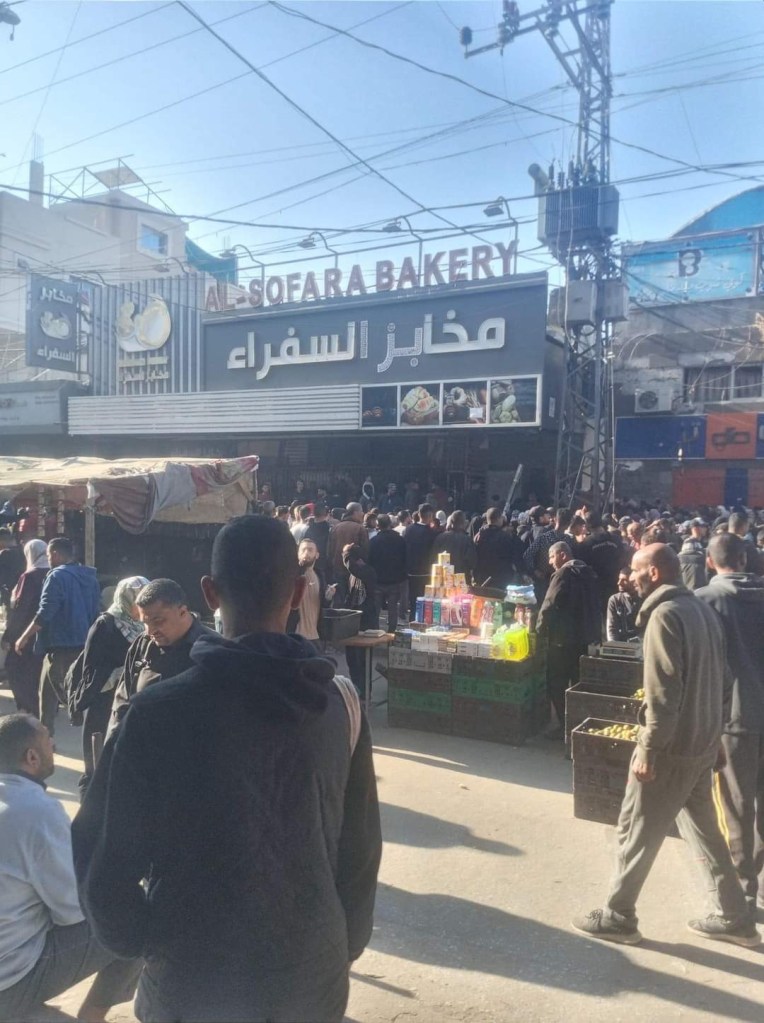
CROWDS OF PEOPLE TRYING TO GET BREAD

Question What You Are Told

Perhaps you will object to what I am about to say, but I think understanding from a “felt” place allows us to feel empathy for others. So bear with me.

Here in Maine, many of us have gone through 3 very difficult days due to the mass killings in Lewiston— sadness for the loss of lives (18 people), and fear knowing the shooter was still somewhere out there.

Across the ocean there is another tragedy occurring where thousands of innocent people have been killed, including over 3,000 children. The sadness is deep for the loss of sons, daughters, husbands, wives, grandparents, aunts , uncles, cousins, friends. The fear is intense and unrelenting— people pushed out of their homes with nowhere to go that is safe. They plea to be heard; plea for the nightmare to stop—bombs falling on places they thought would be safe: schools, hospitals, churches. Food, clean water, fuel, medical supplies are nearly gone.

Response was quick, support made available, and non-stop efforts to find the perpetrator of the violence were put into place — tonight he was found, we are safe, and there is again a national call to ban assault weapons —President Biden taking the lead for the ban. Violence seen for what it is — a tragedy.

No one is coming to their rescue, no one who has decision-making power is trying to prevent the violence. More weapons are being given, more bombs are being dropped, ground troops are preparing to attack. President Biden is taking the lead in supporting Israel. Our leaders are unreservedly supporting those doing the killing. Self-defense they say.

Now from Gaza, no photos, no emails, no texts —no internet. Cut off from the rest of the world. The message is —we don’t want to ignite resistance to the plan. Don’t want the world to sympathize with the injured, dying, dead. Don’t want you to see the shaking babies, the crying children, the devastated mothers, the wasteland that is vast and growing.

This response couldn’t be more different than what we’ve just experienced here in Maine.

What will it take for us to “feel” into the truth? Palestinians are human beings just like we are. Their children are just as precious as my children and your children. What will it take for our eyes to open, our hearts to open— to truly understand that it is our duty as human beings to take care of one another— we are brothers and sisters.

And we should question. Question. Not assume what we are being told by our leaders is true. Because sometimes they don’t tell the truth. They certainly are NOT telling you the truth regarding the Palestinian people and Israel.

Please … question what you are being told.

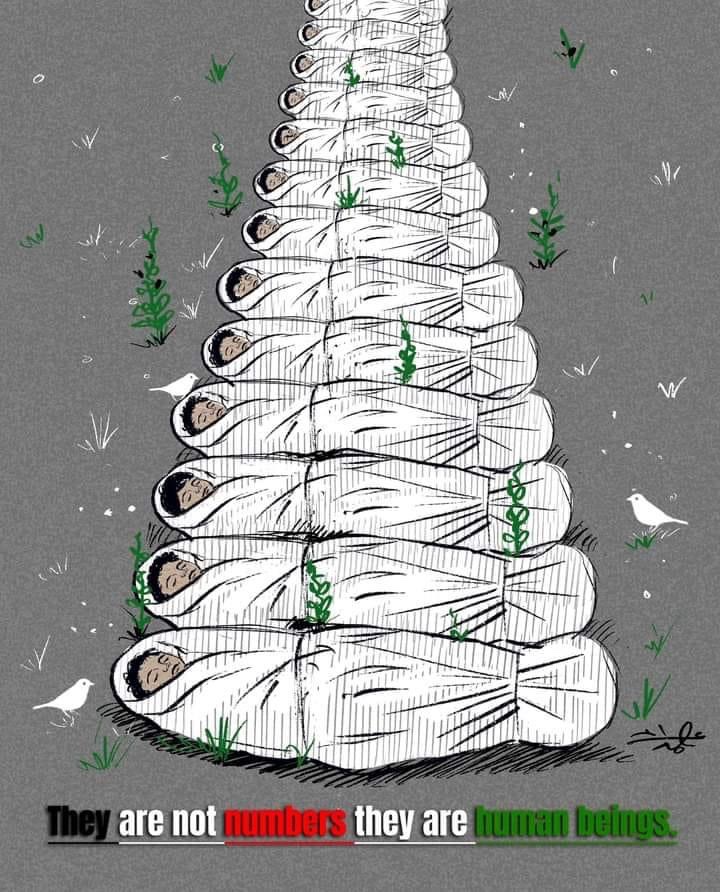
3,000 children? Whether here or somewhere else, violence used to kill children is a tragedy. It’s a tragedy that needs to end.

Photo from FB post

#7 Reflection: A Sad Interlude—July 24: 18 days now

If you are neutral in situations of injustice, you have chosen the side of the oppressor.  
Desmond Tutu
1__#$!@%!#__unknown
(and, then there is ignorance…)

I sit here on the back deck of my home listening to bird sounds, the rustling of leaves from a slow-moving breeze and the distant movement of traffic.  I see moving light on the pond at the bottom of the field below.  I look out onto gardens filled with varying shades of yellow, white, green, and my eyes rest on the peaceful face of the Buddha statue under the apple tree.  What teaching do you have for me this day, dear Siddhartha Gotama, while bombs are falling in Gaza and the people who live there are dying, injured, displaced from their homes?  While, too, my friends in Israel suffer from fear and despair wanting to do something, but feeling ineffectual?

I wake up at night and immediately my head is filled with worry and concern about the people of Gaza.  I check my Facebook to see what news has been posted (I have learned not to rely on the mainstream media for accurate reporting), to see if Khitam has written anything—to know she is alive, uninjured; to let her know I am listening and speaking up.   I look for messages from Rose, my friend from Ramallah; Hamde, from B’ilin.  I follow other friends in human rights organizations I trust and respect:  Jewish Voice for Peace, US Campaign to End the Occupation, Interfaith Peace-Builders, B’Tselem, If Americans Knew, Breaking the Silence and others.  And “share” what I learn (some would say too much).  I read articles and essays and look at photographs that I don’t want to look at.  The most painful ones for me are pictures of mutilated bodies of babies and little children and the anguished faces of their tormented parents.

A couple of days ago, Bob received a call from our friend, Yasser, telling us that two 14 year-old boys from his town, Al-Ram, had just been shot dead by Israeli soldiers (we still haven’t heard about this in the news).  Bob could hear gunfire in the background along with the sound of fear and despair in Yasser’s voice.  Yesterday, we received an email from our Israeli Jewish friend, Iris, who lives just outside Tel Aviv.  She, too, is despairing and deeply frightened.  She and many of her Israeli friends are frantically meeting, planning and organizing protests rallies and events. (We don’t hear about these actions here in our media either.) Her son has refused to sign up with the Israeli Defense Force (IDF).  He won’t have blood on his hands, be part of actions he believes are morally wrong.   He is one of many Israelis doing what he can to end the horror that can have no end from continued acts of horror.  And, as an Israeli citizen obliged to serve his country, there will be consequences.

As I sit in the quiet and safety of my home, I feel tired, deeply sad; and I feel the desire to turn my head away from it all.  (Quickly the thought arises—with judgment and scorn— “YOU are tired!?”)  I do know I need to rest and spend even a few minutes by the pond at the bottom of the field behind my house—to rest in “The Peace of Wild Things”.*  And, then feelings and thoughts of shame arise: this country to which I pay taxes uses over 3 billion of those tax dollars each year to fund the government and military that is massacring the people of Gaza, taking without permission or compensation land that is not theirs, intimidating, restricting, constricting the lives of an entire group of people, letting them know through speech and actions—“you do not belong here.”   My heart screams in agony for the people of Gaza, for the people of Palestine—for the ignorance that perpetuates the violence and occupation of the Palestinian people…that affects the people of Israel and the sustainability of the state of Israel…that affects us all.

It’s all there in what is unfolding, isn’t it?  The truths of kamma (cause and effect), anatta (not-self and the illusion of a sense of identity and separateness), annica (impermanence), dukkha (unsatisfactoriness and suffering).  And, ignorance, like the trump card, is the most powerful part of it all.

I keep hearing in my head the words of Jesus as he was dying on the cross:  “Forgive them Father for they know not what they do.”

*title of a poem by Wendell Berry